

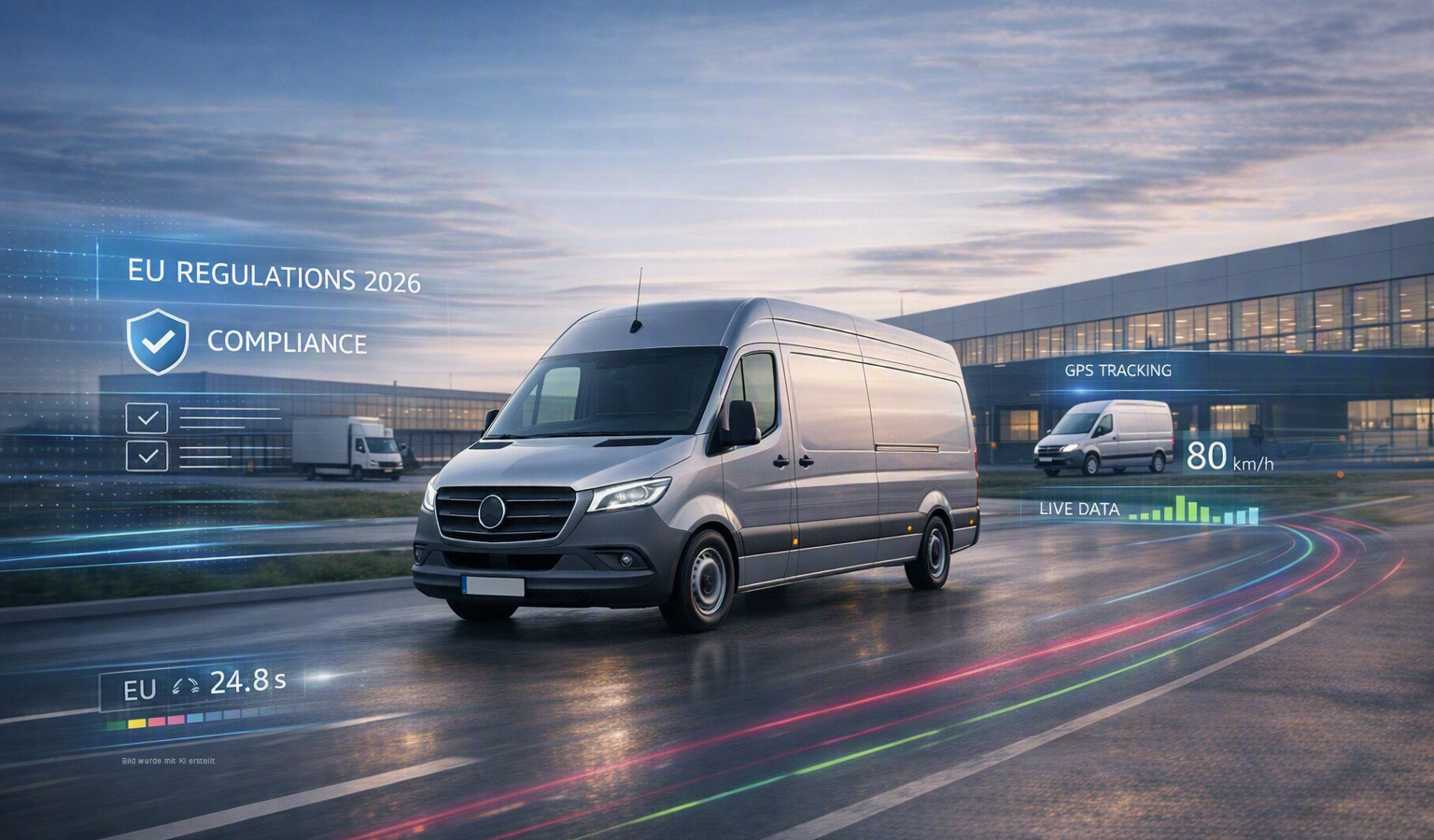
Sprinter im Fokus – EU-Regeln 2026
New EU rules for Sprinter vans from July 2026: a requirement or an opportunity?
From July 2026, new regulations for cross-border freight transport will come into force as part of the EU Mobility Package. For the first time, these will also apply to light commercial vehicles weighing between 2.5 and 3.5 tonnes – in other words, standard Sprinters. For many companies, this means: rules that previously applied only to lorries now apply here too. But what is the reality of the situation – and what does this mean for decision-makers?
How much truth is there really in that statement?
The statement is essentially correct: from July 2026, vehicles weighing over 2.5 t used for international commercial operations will be subject to EU regulations on driving and rest periods, as well as the tachograph requirement. This is based on Regulation (EU) 2020/1054, which extends the scope of application.
In practical terms, this means:
- The smart tachograph (G2V2) is to become compulsory.
- Driving and rest periods are the same as for lorries.
- Posting rules apply to certain journeys.
Important: The regulation applies only to cross-border traffic
This is where things get interesting: The new requirements are complex – and can hardly be implemented efficiently without digital support. addHelix Road addresses this very issue by combining route planning, real-time data and compliance requirements in a single platform. This turns regulatory pressure into a manageable process.
Four benefits of following the rules correctly
1. Greater planning certainty
A clear legal framework enables more structured processes. With addHelix Road, legal requirements can be integrated directly into the planning process – ensuring greater certainty in day-to-day operations.
2. More efficient route planning
Thanks to intelligent route optimisation, driving times, breaks and traffic conditions are automatically taken into account. addHelix Road ensures realistic routes and reduces operational inefficiencies.
3. Transparency & Compliance
All relevant data – from journey times to digital documents – is available centrally. In this way, addHelix Road helps companies to demonstrate compliance at any time.
4. Making better use of resources
Optimised planning reduces empty kilometres and unnecessary journeys. This cuts costs whilst at the same time improving the efficiency of the entire fleet.
FAQs: Key questions for decision-makers
1. Does this apply to all Sprinters?
No. Only vehicles weighing over 2.5 t engaged in cross-border commercial transport are affected.
2. Are there any exceptions?
Yes. For example, in the case of own-account transport, where transport is not the main activity.
3. What exactly do companies need to do?
- Fitting vehicles with smart tachographs
- Train drivers
- Adapting processes and planning
4. What are the risks of non-compliance?
This could result in heavy fines, vehicles being taken off the road or licence issues.
5. Why act now?
Many companies are not yet prepared. Early implementation avoids bottlenecks and creates competitive advantages.
Conclusion
The new EU rules are more than just extra red tape – they are bringing about lasting change to the market. For decision-makers, the key point is this: those who act now and embrace digital solutions can turn this obligation into a strategic opportunity.
With a solution such as addHelix Road, you can not only meet the new requirements but also actively capitalise on them – for more efficient processes, greater transparency and a sustainable competitive advantage.
Public sources:
European Labour Authority – Light Commercial Vehicles
Europäische Kommission – Mobility Package I
EUR-Lex – Verordnung (EU) 2020/1054
IHK – Tachographenpflicht ab 1. Juli 2026
WKO – Smart Tacho 2 Informationen
Author: Karin Saltori, Product Marketing