

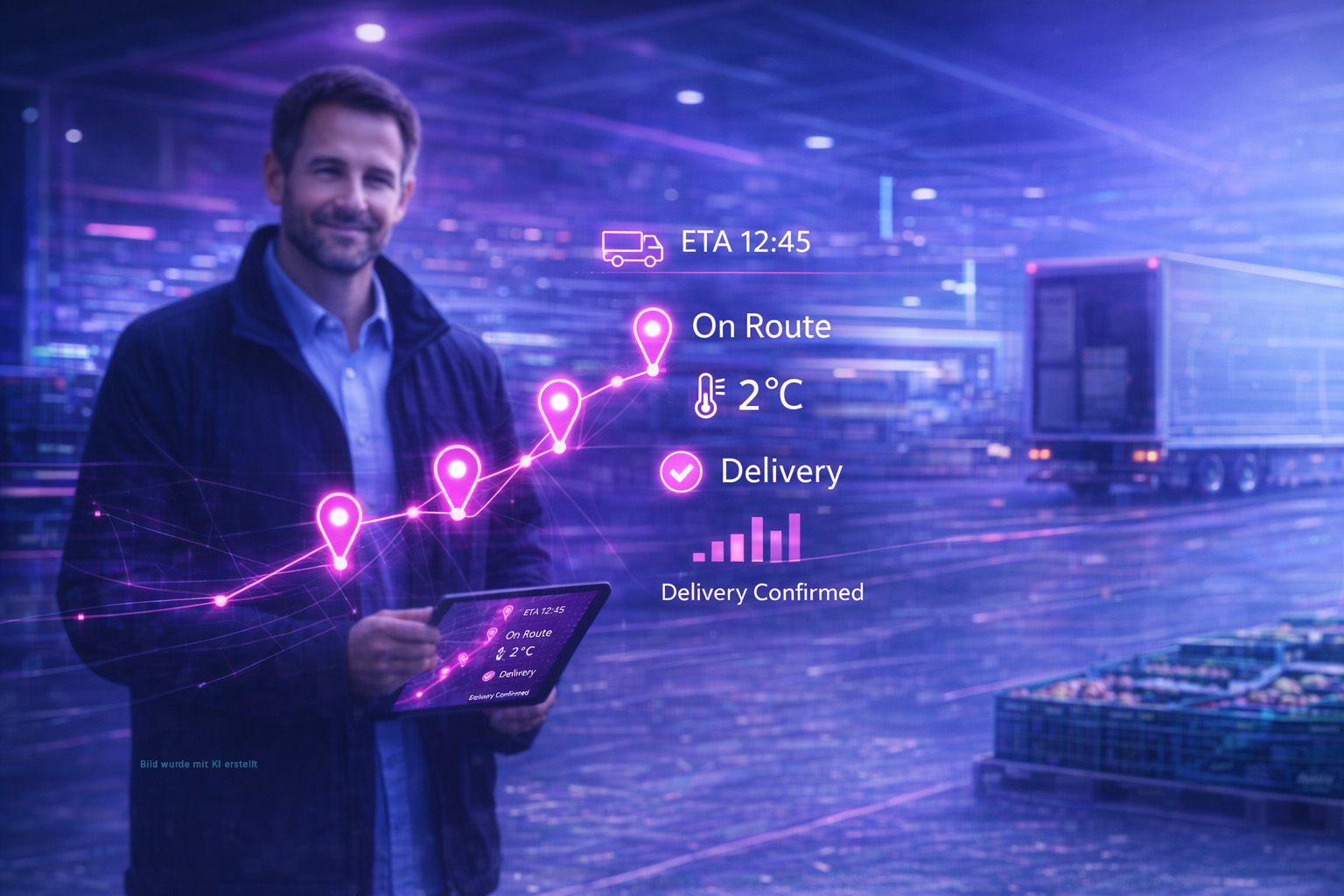
Digitalisation in food logistics
How IoT and real-time tracking create transparency – for SMEs too
The demands of food logistics are constantly increasing: freshness, quality and safety must be guaranteed at all times – amidst increasingly complex supply chains and growing cost pressures.
Digitalisation is no longer just a concern for large corporations. Modern solutions based on the Internet of Things (IoT) and real-time tracking now make transparency a reality for small and medium-sized enterprises (SMEs) as well.
Challenges in food logistics
Foodstuffs are among the most sensitive goods in logistics. Even minor deviations in the transport process can affect quality, shelf life and customer satisfaction. Typical challenges include:
- Lack of transparency during transport
- Time-sensitive delivery windows
- Significant coordination required between dispatch, drivers and customers
- Manual rework in the event of discrepancies or complaints
Without digital support, risks arise that are difficult to control.
Digitalisation as a response to growing demands
Digital solutions lay the groundwork for greater clarity, better decision-making and more efficient processes. Key components of this include IoT (Internet der Dinge) and Real-time tracking.
IoT refers to connected devices and sensors that automatically collect and transmit data – such as location, status or timestamps.
Real-time tracking ensures that this information is always up to date and readily available. This transforms an opaque supply chain into a manageable process.
IoT & real-time tracking: What does this mean in practice?
Thanks to IoT sensors and tracking data, food logistics providers can:
- see where a delivery is at any time
- Identify discrepancies at an early stage
- respond more quickly to delays
Instead of making phone calls or waiting for delayed responses, real-time information is available – for dispatch, customer service and customers alike.
Full transparency with addHelix Road
With addHelix Road, tracking information is consolidated in one place and presented clearly. This makes transport processes consistently transparent – from planning right through to delivery.
The benefits for you:
- Real-time transparency instead of information gaps
- Faster response to deviations
- Better service quality through reliable delivery information
This is how digitalisation brings real added value to day-to-day operations in food logistics.
Digital transformation for all: benefits for SMEs
Many SMEs are reluctant to embrace digitalisation due to concerns about high costs or complex IT projects. Modern cloud solutions significantly lower these barriers to entry.
SMEs benefit particularly from:
- flexible, scalable solutions
- low technical barrier to entry
- Integration into existing processes
- rapid deployment without the need for long-term, large-scale projects
With addHelix Road, SMEs can digitise gradually, without overburdening their organisation.
FAQs: Frequently Asked Questions – Identifying risks, utilising solutions
1. Why does a lack of transparency pose a risk in food logistics?
Risks:
Unclear transport statuses lead to quality issues, customer complaints and a loss of trust among customers.
Solution:
Real-time tracking with addHelix Road ensures end-to-end transparency and reduces uncertainty in day-to-day operations.
2. Isn’t IoT and tracking too costly for smaller businesses?
Risks:
Many SMEs fear high costs and complex implementations.
Solution:
Cloud-based solutions lower the barriers to entry and enable a simple, scalable start – even without your own IT infrastructure.
3. What happens in the event of delays or changes?
Risks:
Problems are often only recognised when it is too late.
Solution:
Real-time information highlights deviations at an early stage and enables swift corrective action.
4. How do customers benefit from digital tracking solutions?
Risks:
Unclear delivery times and a lack of information reduce customer satisfaction.
Solution:
Reliable status updates improve transparency, trust and service quality.
Conclusion: Digitalisation as a key to success in food logistics
IoT, tracking and digital technologies are now essential tools for reducing risks, optimising processes and remaining competitive – regardless of a company’s size.
With addHelix Road Food logistics providers are offered a solution that:
- Transparency creates
- lowers the barriers to entry
- and provides practical support for digital transformation
Take the next step now
You’d like to know how IoT & Echtzeit‑Tracking want to make your food logistics more efficient and transparent? Talk to us about the right digital solutions for your business and
Author: Karin Saltori, Product Marketing