

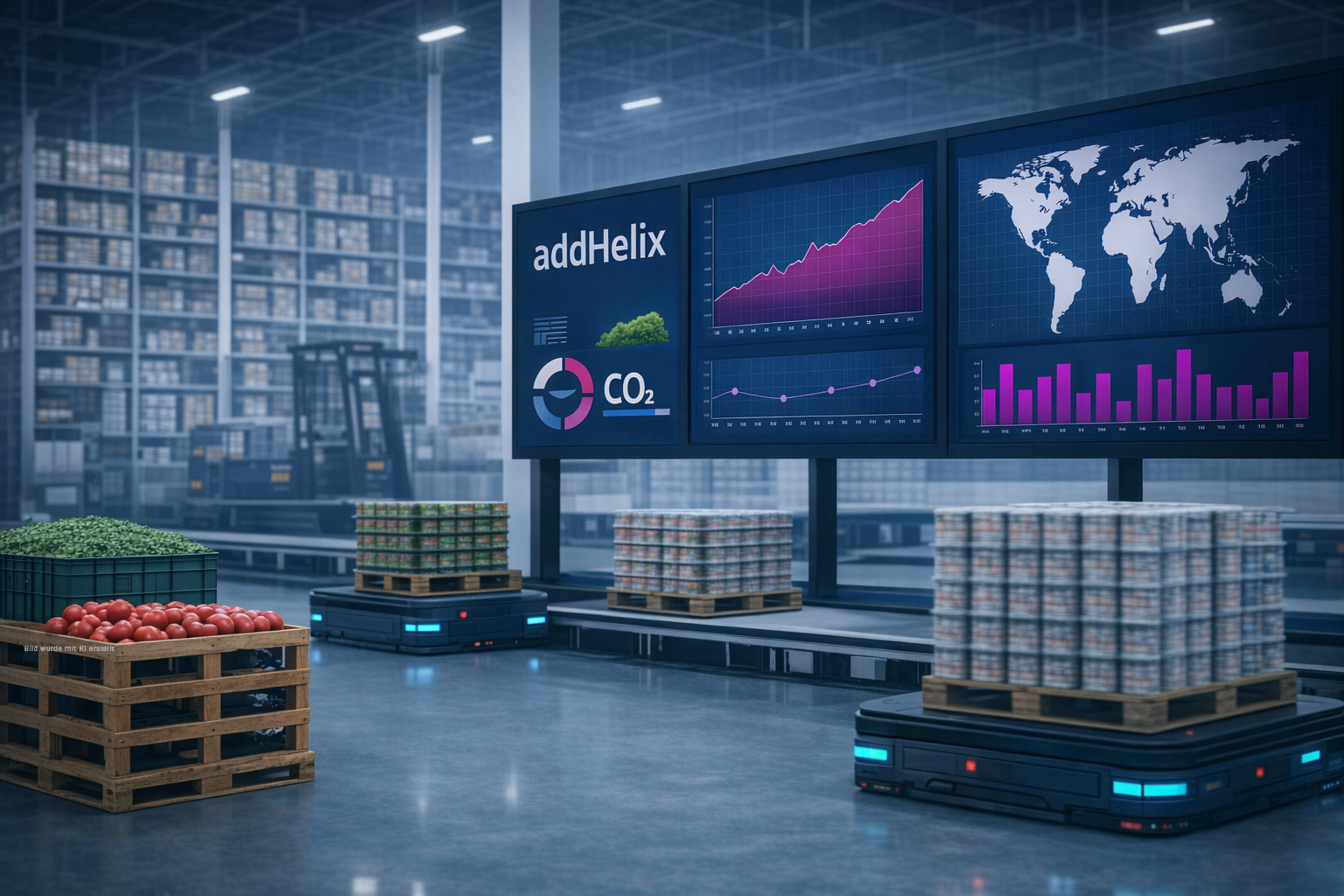
Food logistics in transition
Food logistics in transition: trends, risks and opportunities for 2026
Why food logistics needs to reinvent itself now
Food logistics is at a crucial turning point. Increasing demands on Quality, safety and transparency are facing volatile markets, scarce resources and intense cost pressures. At the same time, customers expect on-time deliveries, full traceability and absolute reliability.
2026 in particular will be a significant year for many food logistics operators – especially SMEs – pioneering:
Those who establish structures early on remain able to act. Those who cling to manual processes quickly reach their operational limits.
Current situation: A high level of responsibility, with little room for manoeuvre
Food logistics differs fundamentally from other transport sectors:
- Tight time slots for collection and delivery
- Temperature-controlled transport and hygiene requirements
- Low tolerance for errors throughout the entire supply chain
- High dependence on planning, drivers and effective processes
Even minor faults can lead to loss of quality, complaints or damage to reputation führen.
For SMEs with small teams, this means having a huge amount of responsibility whilst resources are limited.
The key logistics trends for 2026
1. Transparency throughout the entire supply chain
By 2026, transparency will become the norm. Food logistics providers will need a constant overview of:
- Planned and ongoing tours
- Latest status updates
- Deviations and delays
Only those who keep track of things can react in good time and ensure quality.
2. Flexible rather than rigid planning
Fixed timetables are increasingly reaching their limits. Fluctuations in demand, traffic conditions and last-minute changes have long been part of everyday life.
Modern logistics requires dynamic planning, which enables adjustments to be made in day-to-day operations – without the need for significant manual effort.
3. Quality and safety as a logistical process
Quality doesn’t stop at the warehouse or on the production line.
Transport and delivery are increasingly seen as part of quality assurance.
In 2026, this means:
- Responsibility right down to the last mile
- clear processes rather than reactive problem-solving
- documented processes to ensure traceability and trust.
4. Digitalisation is becoming accessible to SMEs
Digital logistics solutions are no longer just relevant to large companies.
Cloud-based applications in particular make it easy for SMEs to get started – without complex IT projects or lengthy implementation phases.
Risks:
Where food logistics professionals face particular challenges
Despite modern technologies, key risks remain:
- Lack of overview in day-to-day operations
- High dependence on individual dispatchers
- Time-consuming manual planning
- Delayed responses to deviations
These risks have a direct impact on quality, costs and customer relationships – particularly for small and medium-sized enterprises.
Opportunities:
How modern solutions ensure security
Digital logistics solutions open up new possibilities:
- Structured planning rather than relying solely on experience
- Early detection of anomalies
- Reducing the workload on the planning department
- A better basis for decision-making
addHelix Road helps food logistics providers make transport processes transparent, predictable and secure – with a focus on the industry’s real-world requirements.
SMEs Perspective: Working efficiently with small teams
SMEs face the challenge of ensuring the highest quality with limited resources. Solutions that do the following are therefore crucial:
- Easy to use
- Can be put to productive use quickly
- Creating transparency without any extra effort
Digital solutions such as addHelix Road enable SMEs to set up professional logistics structures without overburdening their organisation.
FAQs – Frequently asked questions about food logistics in 2026
1. Why is food logistics particularly challenging?
Because tight deadlines, fragile goods and high quality standards all come into play – leaving little room for error.
2. Which logistics trends are crucial for SMEs?
Transparenz, flexible Planung und digitale Lösungen, die ohne großen IT‑Aufwand eingesetzt werden können.
3. What role does supply chain transparency play?
It enables early intervention, ensures quality and builds trust among customers and partners.
4. How can SMEs prepare for 2026?
Through structured processes, clear lines of responsibility and flexible digital planning solutions.
5. Is digitalisation also beneficial for smaller food logistics companies?
Yes – especially when solutions are practical, scalable and easy to use.
Conclusion: Responsibility requires clarity and structure
Food logistics in 2026 is all about responsibility – for quality, safety and trust.
Companies that structure their supply chain processes at an early stage will benefit from:
- Greater planning certainty
- Improved responsiveness
- Strong customer relationships
Change offers great opportunities – especially for those who actively foster transparency and flexibility.
Take the next step now
Find out how addHelix Road helps food logistics providers make their transport processes secure, transparent and efficient.
Author: Karin Saltori, Product Marketing