

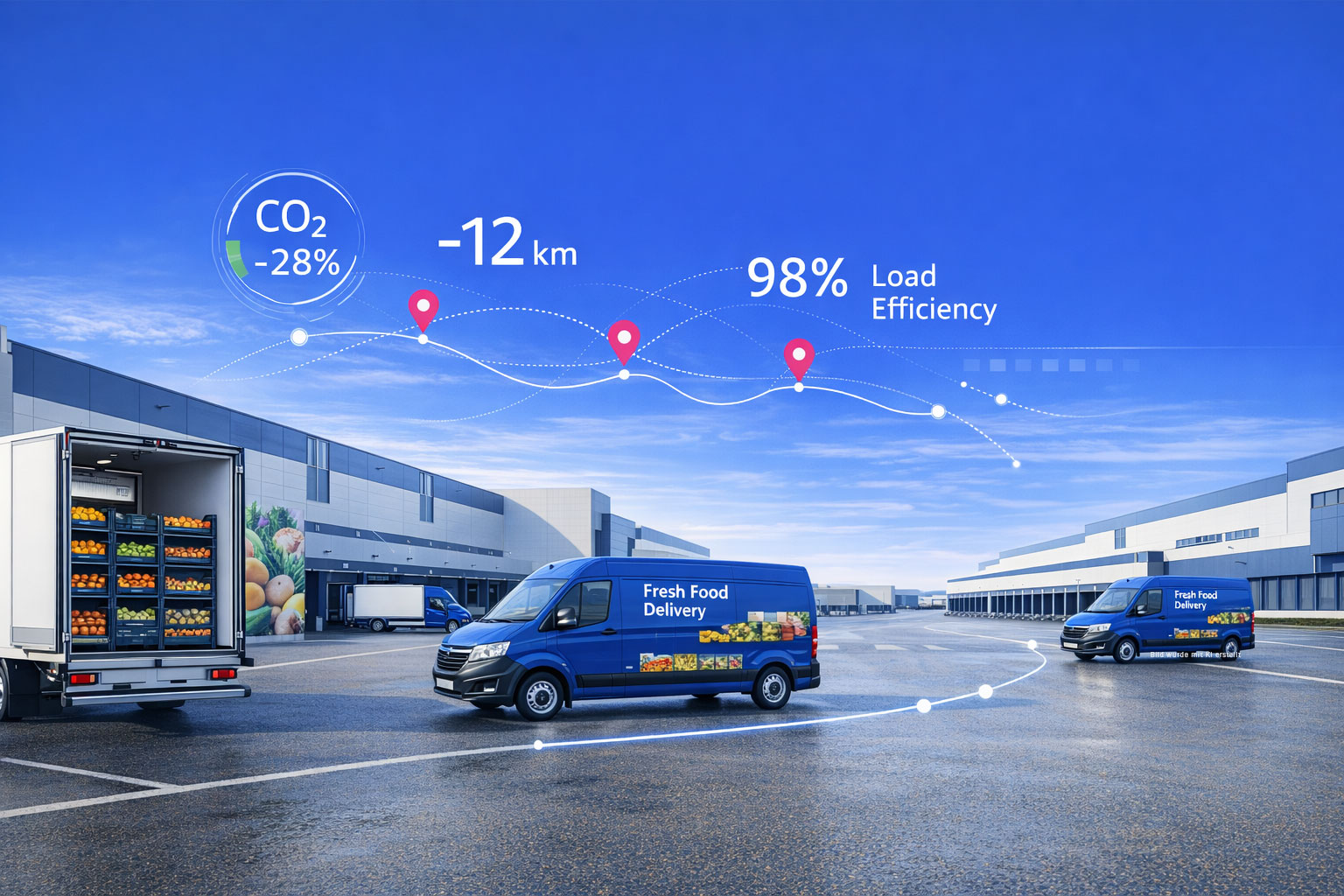
Sustainability in food logistics
Practical steps for small and large businesses
The demands placed on food logistics are constantly increasing:
Freshness, safety and transparency must be guaranteed at all times – even as cost pressures mount and our responsibility towards the environment and society grows.
Sustainability is no longer just a 'nice-to-have', but a key competitive factor.
But how can one Green Logistics put into practice – including for small and medium-sized enterprises (SMEs)? This article outlines practical approaches and scalable measures for more sustainable food logistics.
Why sustainability in food logistics
is so crucial
Food is one of the most sensitive types of goods in logistics. Temperature fluctuations, detours or empty runs not only affect quality and costs, but also the carbon footprint.
At the same time, the expectations of retailers, end customers and legislators are rising:
- Lower emissions
- Transparent supply chains
- Resource-efficient processes
Sustainability thus becomes Management role – independent
by company size.
Key challenges for small and large logistics companies
Many companies face similar questions, albeit under different circumstances:
- High emissions caused by inefficient routes
- Empty runs and poor capacity utilisation
- Limited resources for large-scale sustainability projects (particularly among SMEs)
- Lack of transparency throughout the supply chain
The good news is that sustainability doesn’t have to start with major investments – but with better decisions in day-to-day operations.
Practical steps towards greater sustainability in day-to-day logistics
1. Touren intelligent planen – statt nur verwalten
Optimised route and tour planning reduces unnecessary mileage and significantly cuts fuel consumption.
Fewer detours means:
- Lower costs
- Lower CO₂ emissions
- Higher quality of planning
2. Avoid empty runs and increase capacity utilisation
Vehicles that are not fully utilised are one of the biggest contributors to CO₂ emissions in the logistics sector. Better planning allows journeys to be consolidated and return loads to be integrated – even with complex delivery structures.
3. Transparency as the basis for CO₂ reduction
Only by gaining an overview of journeys, distances and processes can emissions be reduced in a targeted manner. Digital solutions provide the necessary data foundation for measurable reduction in CO₂ emissions – without any additional administrative burden.
4. Thinking about sustainability in a scalable way – particularly for SMEs
SMEs need flexible solutions that grow with the business. Instead of stand-alone solutions or Excel spreadsheets, scalable digital tools crucial for sustainable planning – both today and tomorrow.
Sustainable transport solutions with addHelix Road
With addHelix Road addHelix helps food logistics providers to integrate sustainability directly into their operational transport planning:
- Smart route and tour optimisation
- Reducing empty runs and unnecessary mileage
- Better utilisation of vehicles
- Transparency for informed decisions
The result: less CO₂, greater efficiency – regardless of whether it is a small regional business or a larger logistics network.
Green logistics is not a project – it is a process
Sustainability in food logistics is not achieved through individual measures, but through consistent optimisation across the entire supply chain.
Digital solutions help you to follow this path in a structured and practical way – step by step.
FAQs: Frequently asked questions about sustainable food logistics
1. What is Green Logistics?
Green Logistics refers to logistics processes that specifically take into account environmental factors such as CO₂ reduction, resource conservation and efficient transport routes.
2. Is sustainable logistics only relevant for large companies?
No. SMEs in particular benefit from scalable solutions that combine efficiency and sustainability without high barriers to entry.
3. How can I reduce CO₂ emissions in the short term?
Emissions can be significantly reduced simply through optimised route planning, improved vehicle utilisation and fewer empty runs.
4. What role does digitalisation play in sustainable logistics?
Digital solutions create transparency, enable better decision-making and make sustainability measurable and manageable.
Take the next step now
Find out how addHelix Road can help you achieve more efficient and sustainable food logistics.
Author: Karin Saltori, Product Marketing