

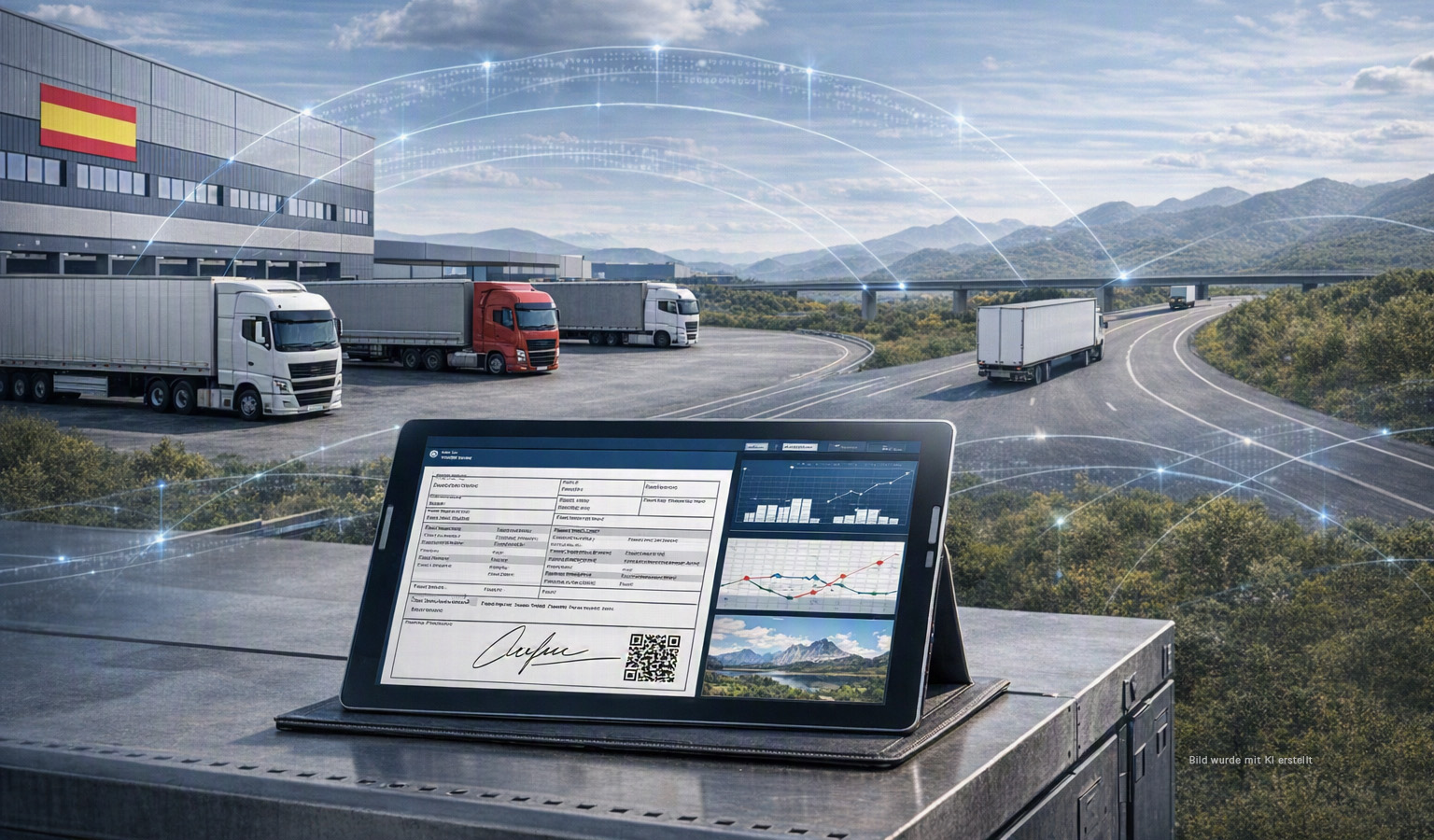
Spain is digitising its logistics sector
Spain leads the way – Why the requirement for digital transport documents is transforming logistics
The digitalisation of logistics is becoming mandatory: with the introduction of digital transport documents, Spain has become the first EU country to set a clear regulatory milestone. From October 2026, transport documents for road freight transport must be available in digital form. This creates an urgent need for action on the part of businesses – particularly SMEs. At the same time, it is becoming clear that, in conjunction with the eFTI Regulation, the industry is moving decisively towards mandatory eCMR across Europe. Those who act now will secure a competitive edge and future-proof their business.
Spain and the EU: The regulatory turning point
Spain requires companies to use a digital control document (DCA). Paper-based documents are no longer accepted during checks. Crucially, a correctly implemented eCMR can meet these requirements and replaces the national document.
At the same time, the eFTI Regulation (EU 2020/1056) establishes the European framework. From 2027, public authorities will be required to accept digital freight information. Although its use is still voluntary for businesses, Spain is clearly pointing the way forward: Digital transport documents are becoming the norm in Europe.
Four advantages of digital transport documents
1. Improving efficiency in day-to-day operations
Digital processes enable immediate access to transport data. Checks are speeded up and waiting times are reduced. For decision-makers, this means faster processes and better capacity utilisation.
2. Reduction in costs and effort
Paper, printing and manual processing are no longer required. Data is processed automatically and integrated into existing systems. This offers a clear advantage, particularly for SMEs: less effort combined with greater efficiency.
3. Greater transparency throughout the supply chain
Everyone involved has access to the same information in real time. This reduces errors and improves collaboration. Transparency forms the basis for better decision-making.
4. Legal certainty and sustainability
Digital documents meet legal requirements and can be archived in an audit-proof manner. This ensures that companies are optimally prepared for future developments. Compliance becomes simpler and more predictable.
FAQs: What decision-makers need to know now
1. Is eCMR compulsory in Spain?
Not exactly. A digital control document is mandatory – however, an eCMR can fully replace it provided all requirements are met.
2. Does this rule also apply to international transport?
Yes. Shipments involving Spain must comply with the digital requirements.
3. What does the eFTI Regulation cover?
It requires EU authorities to accept digital freight information. The aim is to achieve a standardised, digital exchange of data in the transport sector.
4. What does this mean in practical terms for SMEs?
Anyone supplying goods to Spain must take action by October 2026 (DCA requirement). Other EU countries: There is no legal obligation for SMEs themselves, but it makes good business sense to start preparing now.
5. How can the transition be successfully achieved??
By analysing existing processes, selecting suitable solutions and integrating them into the IT landscape. Solutions such as addHelix eCMR help to ensure the seamless implementation of digital consignment notes.
Conclusion
By making digital transport documents mandatory, Spain is setting a new standard in Europe. For businesses, this provides a clear impetus towards digitalisation. Those who act early will benefit from more efficient processes, greater transparency and legal certainty. At the same time, the groundwork is being laid to ensure that future requirements relating to a possible mandatory eCMR across Europe and the eFTI Regulation can be met without any problems.
Would you like to know whether your systems meet the requirements for digital transport documents?
Public sources:
DVZ – Deutsche Verkehrs-Zeitung
Bundesministerium für Digitales und Verkehr (BMV)
Gesamtverband Verkehrsgewerbe Niedersachsen (GVN)
EU-Kommission – eFTI Verordnung (EU 2020/1056)
Author: Karin Saltori, Product Marketing